Property Investment and Valuation: Note 1(a)

3 types of interest
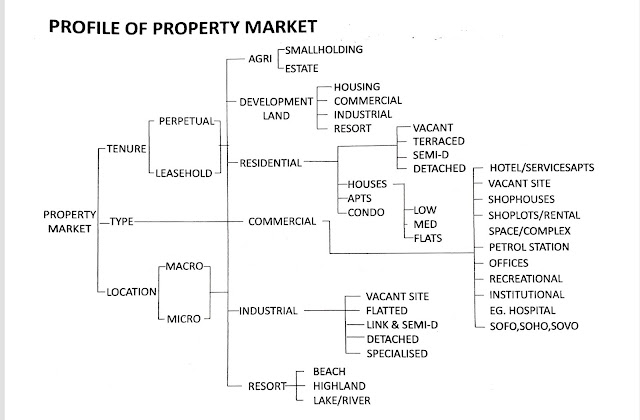
There are three types of interest that exist in any property, otherwise known as 'kepentingan', or in a much simpler language 'ownership' or 'pemilikan' (though technically this would be wrong).
The first one is Freehold.
Freehold interest should be more correctly referred to as an interest in perpetuity. It is regarded as as the ultimate in ownership of landed property. It is not a wasting asset as it will remain as the property of the registered proprietor for ever until of course he or she sells the interest in perpetuity to some one else.
Thus the owner of such property enjoys free ownership for perpetuity and can use the land for any purpose in accordance to local regulations. Sale of a freehold property does not require consent from the state and requires less, making it more expensive than leasehold properties.
The most valuable of the freeholders' proprietary rights are those which enable them to develop, sell, transfer or create lesser interests in their land. These lesser interests will be considered later.
Next is the Leasehold.
A leasehold interest is an interest which persists for a fixed period of time, for example 999 years, 99 years, 60 years, 30 years etc. A leasehold interest reverts back to the State Authority once it lapses. Thus this means that the leasehold interest is a temporary interest in the land. A leasehold interest would generally be deemed a wasting asset.
Upon expiry, the owner can apply for renewal of ownership which costs a portion of the property's market value. The State Government reserves the right to continue leasing or revoke the ownership. Extra legal procedures are required if the owner wishes to make changes to the leasehold structure or ownership.
Presently leasehold interests are the only form of interests generated by State Authority when alienating land. Previously the State Authority was also alienating land on an interest in perpetuity basis however this has been stopped indefinitely.
Leasehold interests which are long (eg. 999 years, 99 years) are also able to create lesser interests in them (sub-lease), as long as it is for a duration shorter than the original lease.
The third one is Temporary Occupation License (TOL).
A Temporary Occupation License (TOL) is a license issued by the State Authority for the temporary use of State land or for the purpose of the retention of minor encroachment from private properties onto State land.
When the State Authority disposes land, it can carry disposal in the form of a Temporary Occupation License (TOL). TOL is there for an interest in landed property.
Section 65(1) of the National Land Code specifies that TOL can be issued for the following;
- State Land
- Mining land for the time being not used for mining
- Reserved land not for the time being used for the purposes for which it was reserved
The TOL interest cannot be used for the purpose of mining or removal of forest produce. TOL will always expire at the year it commences unless it is for the purpose of enabling any public exhibition or entertainment. The TOL is riddled with restrictions and it cannot be assigned to someone else.
Comments
Post a Comment